


HONESTY IS THE ROOT
Quality is always satisfactory
Hotline
400-606-8981
PRODUCT CATEGORY
LATEST NEWS
MORE
PRODUCT DETAILS
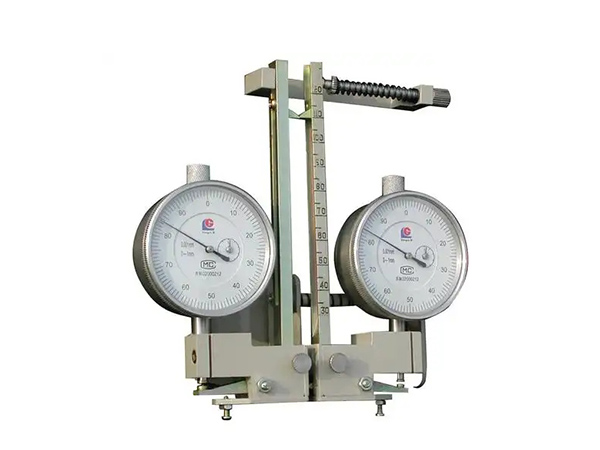
The DY-2 butterfly extensometer is suitable for measuring various small displacements of materials, in order to obtain indicators of certain mechanical properties of materials. The butterfly extensometer has a simple structure, easy use, excellent performance, good adaptability, long economic time, and can be reused. It can also improve the sensitivity of measurement by increasing the gauge length. This instrument is lightweight, with clear readings and a compact structure. It can be selected with a dial gauge and micrometer according to different accuracy requirements. Therefore, this instrument is necessary and ideal for material testing
Butterfly extensometer is mainly used to measure certain mechanical properties of metallic materials and some non-metallic materials. It can be used in conjunction with a high-performance testing machine to measure the displacement or strain of materials, and the elastic mold and yield strength of the material can be obtained through conversion. And it can be used for deformation control in steel bar tensioning process. The butterfly extensometer can be used under various conditions and can be used both indoors and outdoors to determine the deformation of solid fibers without the need for correction. Therefore, it is widely used in the measurement, analysis, and control of industrial displacement or strain. The measurement of the mechanical properties of threaded steel bars is particularly excellentStructure and principle of butterfly extensometer
The butterfly extensometer mainly consists of three parts: the sensing deformation part, the transmission part, and the indication part.
(1) Feel the deformation part: mainly composed of the upper and lower cutting edges. And directly in contact with the test rod. The upper blade can move up and down on the model. Fixed in the selected position. The cutting edge can rotate around its own midpoint. The lateral movement of the upper and lower cutting edges is achieved by the spring embedded in the guide rod moving within the guide sleeve. The longitudinal distance between the upper and lower cutting edges is the gauge length of the specimen, and the transverse distance is the range of diameter variation of the specimen. The upper and lower cutting edges have high hardness and performance (2) Transmission part: The deformation is transmitted to the scale through two movable lower blades mounted on the left and right main bodies, with one end of the movable blade having a 60 degree sharp angle. The other end is embedded with excellent quality and has undergone quenching and hardening treatment. Under the activity, the cutting edge is supported on the spiral cone tips of the left and right main bodies, forming equal arm levers. The coordination between the two support points affects the sensitivity of the scale, while a 1:1 arm length ratio relationship will directly affect the value of the scale. When the extensometer is working, the task of the transmission part is to transmit the deformation within the gauge length range of the sample to the matching gauge, which is intuitively reflected by the rotation of the pointer (3) Indication section: The two gauges used with this type of extensometer (dial gauge with a division value of 0.01mm or dial gauge with a division value of 0.001mm) can be selected according to different accuracy requirements. The end of the measuring rod of the scale is embedded with a hard alloy piece, which has been ground to a smoothness of ▽ 10 or above. The dial gauge is calibrated according to the GB1219-85 standard, and the micrometer is calibrated according to the JB1079-75 standard and has passed the inspection. From the figure, it can be seen that when the upper and lower cutting edges of the butterfly extensometer are tightly clamped on the specimen. The axial displacement generated by the force on the specimen causes the blade to rotate around the midpoint during movement. Due to the lever ratio of 1:1, the scale reflects the axial displacement value. From the principle of construction, it can be known that the sensitivity of the butterfly extensometer for strain measurement is variable, and the sensitivity increases with the increase of the gauge length. However, at this time, the range of the instrument becomes smaller because the range of the gauge is fixedDY-2 butterfly extensometer, extensometer, new standard butterfly extensometer Main specifications
1. Large size of clamping specimen: cylindrical specimen diameter 0-40mm, plate specimen thickness δ 0-40mm.
2、 Range of gauge size: 30-80mm; 30-120mm; 30-250mm
3、 Matching scale: dial gauge: measurement range: 0-3mm division value: 0.01mm dial gauge: measurement range: 0-1mm division value: 0.001mm
4. Matching scale accuracy level: Level 1
DY-2 butterfly extensometer, extensometer, new standard butterfly extensometer usage method
1. Determine the gauge length value and select the gauge according to usage and actual needs
2、 Adjust the position of the upper blade so that the distance between the upper and lower blades is equal to the gauge value
3、 Loosen the fastening screw to adjust the position of the gauge, so that the bottom surface of the upper blade is in contact with the positioning screw on the bottom plate, and the gauge plane is in good contact. When measuring tensile deformation, the starting position of the gauge should be at least 0.1mm above the forward stroke of the pointer. It should be noted that when tightening the gauge, the measuring rod should be protected to move up and down freely and not get stuck. If reused, there is no need to adjust the position of the scale every time the experiment is conducted
4、 Grasp the butterfly extensometer, compress the spring to separate the two cutting edges, and clamp it onto the specimen. If the clamping force is insufficient, adjust the connecting plate spring cap
5、 When increasing the clamping force of the upper blade, a clamping frame should be used on the model, and its position should be as close as possible to the upper blade. The clamping force can also be adjusted through a spring cap
6、 Calculate the elongation of the specimen within the gauge length range by taking the average of the values in the two tables
Maintenance points for butterfly extensometer
1. The butterfly extensometer is made of aluminum alloy material and equipped with a detailed gauge. When using it, it needs to be handled with care.
2、 The measuring head, upper and lower cutting edges should be kept clean, wiped clean after use, coated with anti rust oil, covered with a cutting edge protective cover, and placed in the box
3、 The lower cutting edge of the butterfly extensometer is supported by two cones, which have been adjusted before leaving the factory and cannot be adjusted arbitrarily
4、 When the deformation of the tested piece exceeds the large range, the butterfly extensometer needs to be removed and stopped from use to avoid damaging the instrument
5、 When adjusting the spring clamping force with a spring cap, it is necessary to return the spring cap to its original position after using the instrument