


HONESTY IS THE ROOT
Quality is always satisfactory
Hotline
400-606-8981
PRODUCT CATEGORY
LATEST NEWS
MORE
PRODUCT DETAILS
1、 Overview
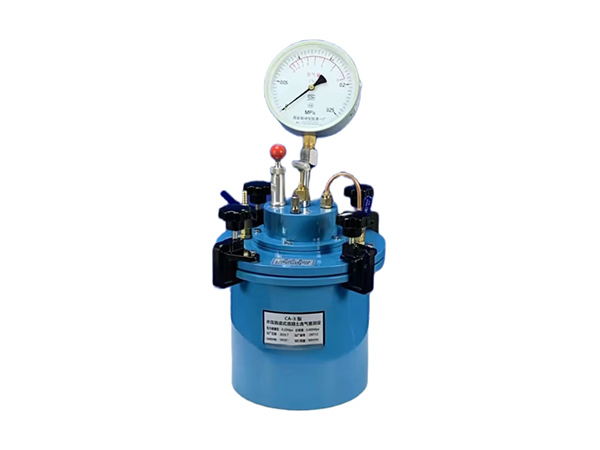
The HC-7L concrete air content analyzer is used to measure the air content in concrete mixtures. It is suitable for concrete with aggregate particle size not exceeding 40mm, air content not exceeding 10%, and slump. This machine has the advantages of easy operation, accurate measurement, and intuitive reading, and is an excellent air content meter for concrete mixtures. The measuring method of the concrete air content meter complies with the relevant provisions of GBJ80-85 (Performance Test Method for Ordinary Concrete Mixtures) on the testing of air content in concrete mixtures.
2、 Technical parameters
1. Measuring bowl capacity: 7 liters (with an inner diameter equal to the scale)
2. Gas content range: ≤ 10%
3. Use coarse aggregate with a large particle size: ≤ 40mm
3、 Determination of Air Content in Concrete Mixtures
1. Wipe the measuring bowl and the inner surface of the bowl cover with a damp cloth, and place the measuring bowl horizontally.
2. Evenly fill the freshly mixed concrete mixture into the measuring bowl, so that the concrete mixture is slightly higher than the measuring bowl. When loading materials, a tamping rod can be used to slightly insert and compact them. After installation, when using a vibration table (with a frequency of 50HZ and an amplitude of 0.5 ± 0.1mm when unloaded) to vibrate, if the concrete mixture sinks below the inner mouth during the vibration process, the concrete mixture should be added at any time and vibrated until the surface of the concrete is flat and glazed, then the vibration should be stopped. When using a tamping rod instead of a vibration table, the concrete mixture is divided into three layers and each layer is compacted to about one-third of the height of the measuring bowl. When inserting the tamping rod into the stratum, it should penetrate the entire scale. When pounding the upper layer, the pounding rod should be inserted 10-20mm into the lower layer. After each layer is compacted, the tamping rod can be placed on the lower part of the measuring bowl, and the measuring bowl can be alternately shaken left and right on the ground 15 times.
3. After the compaction is completed, the excess concrete mixture on the surface should be immediately scraped off with a scraper. If there are any depressions on the surface, they should be filled, and then smoothed with a trowel to make the surface smooth and free of bubbles.
4. Clean the edges of the measuring bowl and bowl cover, place the O-ring rubber seal (238 × 8.6) in the groove on the edge of the bowl cover, cover the bowl cover, clamp it with a clamp to ensure good airtightness, and check the level with a spirit level.
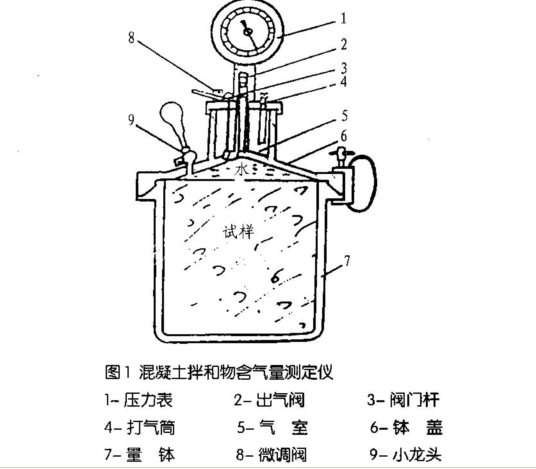
5. Open the water service for Chenghe exhaust valve, use a water injector to inject water from the small service for Chenghe into the measuring bowl until water flows out from the valve port, and then close the small service for Chenghe exhaust valve tightly.
6. Close all valves and use a pump to inflate and pressure the gauge slightly above 0.1MPA. Note: (1) Whenever reading the pressure, lightly tap the dial with your fingertips and wait for the pointer to stop swinging before reading. (2) The 0.1MPA pressure line is the initial pressure line of the instrument, and 0.1MPA is the initial pressure of the instrument.
7. Press the valve stem 2-3 times, lightly tap the circumference of the measuring bowl with a wooden mallet to evenly distribute pressure throughout the sample, press the valve stem again, wait for the pressure gauge pointer to stabilize, measure the pressure gauge reading, and based on the calibrated relationship curve between the air content and the pressure gauge reading, measure the air content A value of the concrete mixture sample measured by the instrument.
After the testing is completed,
1. Open the air outlet valve and prevent air from entering the measuring bowl. If it is necessary to repeatedly measure the gas content of the same sample, repeat steps 5-7 above.
2. Open the small service for sincerity, send the clamp open, and remove the bowl cover.
3. Pour out the concrete mixture sample from the measuring bowl, clean the bowl cover and the inner surface of the measuring bowl.
4. If the gas content analyzer is not used continuously. Open the fine adjustment valve to release air and make the chamber pressure consistent with the atmosphere.
Note: During the operation, if the pressure in the chamber is released through the fine adjustment valve and there is still pressure in the measuring bowl, the valve rod should not be pressed appropriately, otherwise water will be sucked into the chamber, causing errors in future testing.
4、 Determination of concrete mixtures
1. Before measuring the air content of concrete mixtures, the air content value of aggregates should be measured first, and the measurement method should be carried out according to the following steps. Press to calculate the weight of coarse and fine aggregates in each sample.
In the formula: WG, WS - are the weight of coarse and fine aggregates in each sample (KG) V - the volume of the measuring bowl of the air content analyzer (liters) Gg, Cs - are the amount of coarse and fine aggregates used per cubic meter of concrete (kg), respectively
2. First, fill the measuring bowl with water at a height of one-third. Mix the weighed coarse and fine aggregates evenly and slowly pour them into the measuring bowl. When adding the sample, try to minimize the introduction of air. For every 20-30mm increase in water level, gently tap the measuring bowl 10 times and stir it slightly. Tap the measuring bowl lightly at any time to eliminate air. During the feeding process, always keep the water surface higher than the top surface of the discharged material. After the aggregate is fully added, soak it for five minutes, tap the wall of the measuring bowl gently to remove bubbles, then remove the foam from the water surface, and add water to the top.
3. Clean the edges of the measuring bowl and bowl cover, place the O-ring (230 × 8.6) in the groove on the edge of the bowl cover, cover the bowl cover, clamp it tightly with a clamp to ensure good airtightness, and check the level with a spirit level. The remaining steps shall be carried out in accordance with the relevant regulations for measuring the air content of concrete mixtures, and the air content C of the graded aggregate shall be measured.
5、 Calculation of Test Results for Concrete Air Content Tester
The gas content is calculated according to the following formula:
A=A1-C
Among them: A-concrete mixture quantity (%)
A1- Instrumental determination of gas content (%)
C-aggregate gas content (%)
Take the average of two measurements as the experimental result. If there is a difference of more than 0.2% between two gas content measurements, the reason must be identified and the test must be redone.
6、 Calibration of instrument gas content:
Each instrument has been accurately calibrated before leaving the factory, and calibration results are available. However, it is also feasible to recalibrate from time to time to protect the accuracy of the air content measurement of the concrete mixture. Calibration includes the following three steps:
1. Calibration of measuring bowl volume
a、 Prepare a flat glass plate and weigh W2 (accurate to 0.05kg) together with an empty measuring bowl;
b、 Fill the container with water and slide a glass plate along the upper edge. Use a water injector to add water from time to time until the measuring bowl is filled with water and there are no bubbles under the glass plate. Weigh the measuring bowl filled with water together with the glass plate to obtain a weight W1 (accurate to 0.05kg). The volume V of the measuring bowl is:
W=W1-W2(W、W1、W2-kg)
V=W1-W2(W、W1、W2-kg)
V=W/r(V-L)
The specific gravity of water at the temperature during calibration (r-kg/L)
2. Calibration of zero point 0% gas content.
a、 Fill the measuring bowl with water and connect the calibration tube 2 to the small end under the bowl cover.
b、 Open the small service for sincerity, gently place the bowl lid on the measuring bowl, clamp it tightly with a clamp, and check the level of the instrument with a spirit level,
C、 Send out the air valve, use a water injector to add water from the small service outlet until water overflows from the outlet of the air outlet valve, and then close the small service outlet and air outlet valve. Note: The space under the bowl cover needs to be fully filled with water, otherwise the reading will not reflect the correct gas content value.
d、 Use an air pump to inflate and increase the pressure slightly above 0.1MPA, stop for 5 seconds, adjust the pressure with a fine adjustment valve to accurately stop at 0.1MPA, tap the dial lightly, and the pressure remains at 0.1MPA. Then press the valve stem 2-3 times to balance the chamber pressure and the measuring bowl pressure, and read the pressure gauge value as 0% gas content.
3. Calibration of Gas Content Scale from 1% to 10%
After calibrating the instrument with a gas content of 0%, connect calibration tube 1 to the top of the bowl cover and use calibration tube 1 to suck water from the measuring bowl into the measuring cylinder. The specific operation method is as follows:
a、 Press the valve stem and slowly open the small service for sincerity. The water in the measuring bowl will flow into the measuring cylinder through the calibration tube 1. If the water flow is not smooth, first close the small service for sincerity.
b、 Open the air outlet valve to balance the pressure inside the measuring bowl with atmospheric pressure, then close the air outlet valve and use an air pump to increase the pressure slightly above 0.1MPA, and stop for 5 seconds.
C、 Adjust the pressure with a fine-tuning valve to accurately stop the gauge pressure at 0.1MPA, stop for 5 seconds, press the valve stem 2-3 times, and wait for the pointer to stabilize. At this time, the pressure value read is equivalent to 1% of the gas content. The same method is used to measure 2%, 3%, 4% 10% of the pressure gauge reading.
d、 Strictly calibrate twice according to the calibration order, and obtain 0%, 1% Take the arithmetic mean of the two readings corresponding to the pressure gauge reading at the 10% gas content point. Plotting the relationship between gas content and pressure values with the average pressure value as the horizontal axis and gas content value as the vertical axis should comply with Bohr's law (p1v1=p2v2). If significant deviations are found, the cause should be identified and recalibrated.