


HONESTY IS THE ROOT
Quality is always satisfactory
Hotline
400-606-8981
PRODUCT CATEGORY
LATEST NEWS
MORE
PRODUCT DETAILS
1、 Product Introduction
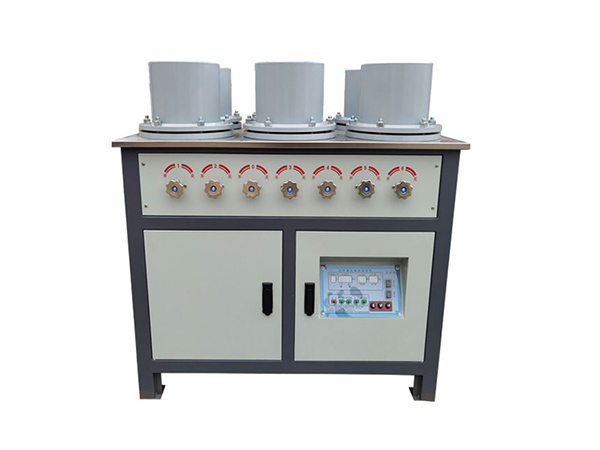
The HP-4.0 automatic pressure regulating concrete impermeability tester is suitable for testing the impermeability performance of concrete and determining the impermeability grade. It can also be used for measuring the permeability of building materials and quality inspection. Therefore, it is widely used by relevant departments such as production, construction, design, and research
2. Main technical parameters
1. Large working pressure: 4MPa
2. Working mode: automatic constant pressure
3. Number of test pieces that can be made at once: 6
4. Geometric dimensions of the test mold (also known as the main mold)
Upper diameter: 174mm
Lower diameter: 185mm
Height: 165mm
5. Piston pump parameters:
Flow rate 0.11L/min, pump plunger diameter 12mm, stroke 10mm, reciprocating frequency 154 times/minute
6. Motor:
Power: 90W 1390r/min
Power supply: 380V-50HZ
7. Dimensions: 960 * 650 * 975mm
8. Weight: ≈ 210kg
III. Working Principle and Mechanism
HP-4.0 Concrete Impermeability Tester is a simple device that uses the principle of equal pressure at various points of the pipeline system connected to a sealed container (neglecting water head), applies pressure with a water pump, and maintains the pressure within a specified range through an intelligent numerical control gauge for testing
The HP-4.0 concrete impermeability tester is mainly composed of a frame test mold, a separator, a water pump, a water storage tank, and an electrical control part. The structure and function of each part are described as follows:1、 Rack trial molding section:
The frame is made of welded steel sections, with a 1.5mm thick steel plate tray laid on top. The test mold base tray is fixed to the frame with M10 bolts, and the test molds are connected to each other with M12 bolts. The "O" - shaped rubber ring in the middle provides a sealing effect. The specimen is formed from pig iron and encapsulated in a test mold, which is fastened using a one-to-one hexagonal wrench2. Separators section:
The separator is a device that places valves and a return water shut-off valve in front of the instrument, mainly used to control the opening or closing of the water circuit for six specimens. The return water shut-off valve is used to reduce pressure3、 Water pump section:
The water pump is powered by a 90 watt electric motor, which changes speed through two pole gears to drive the eccentric shaft to rotate, and then drives the plunger to perform reciprocating motion through guide columns and connecting rods to work. Due to the small flow rate of the water pump, it can be approximately assumed that the water pressure supplied to the specimen is static4、 Storage tank section:
A water storage tank is a container for storing water and can also reduce the impact of pressurized water. Before the test, a funnel is used to inject water into the water storage tank through a water injection nozzle. After the test is completed, the water in the tank is drained through a water discharge nozzle5、 Electrical control section
4. Test steps:
1、 Sample forming and curing, using a forming mold (also known as a secondary mold) according to the material ratio required by the design, and then curing according to the specifications of the department or reputation standards
2、 On the day before the experiment, remove the specimen from the curing room, heat the test mold to around 40 ℃ and heat the wax used for sealing until it melts completely. Then roll the circumference of the specimen in the solution once (wax is strictly prohibited on both ends of the specimen), and press the specimen stained with wax into the test mold with a press
3、 Penetration test
(1) Water filling: Unscrew the nut of the water injection nozzle, open each gate at the same time, place the funnel on the water injection nozzle, fill the water tank with water until it is full, and require the test mold chassis to be filled with water (to eliminate air in the pipeline system). At this time, the six gates leading to the test mold can be closed
(2) Installation of test mold: Install the sealed test mold onto the instrument in a good manner (3) During the test: According to the new specifications, it should be completed within 24 hours. For example, if the project requires the test block to be pressurized to 0.8 MPa, the lower limit should be set to 0.6 MPa. After 8 hours of constant pressure, the lower limit should automatically increase to 0.7 MPa. After another 8 hours of constant pressure, the lower limit should automatically increase to 0.8 MPa, and the test should be completed after 8 hours (4) When two of the end faces of the six specimens show infiltration of pressure water, record the water pressure at this time as the pressure value for the test5. Troubleshooting
1. Cut off valve
Troubleshooting methods
Leakage of debris on the sealing surface
Worn, washed or removed for cleaning
Re grind or replace
Leakage of packing at the packing location
Failure of packing due to prolonged use
Tighten the gland nutReplace with new packing
Pump body
Troubleshooting methods
Leakage of packing at the packing location Tighten the gland nutFailure of packing due to prolonged use
Replace with new packing
(i.e. oil immersed asbestos thread)
The pump cannot suction water. The steel ball on the left side of the water inlet nozzle is blocked
The steel ball on the water outlet nozzle has debris. After starting up, tap the left side in and out twice.
Simply unscrew the M ¢ 8
screw on the water outlet nozzle of the water pump and wipe the steel ball clean.
6. Maintenance
1 Inject a certain amount of butter into the gearbox and replace it according to the situation
2、 The piston and two guide columns of the water pump should be lubricated with oil every 8 hours, with 3-4 drops each time
3、 After each test, the water in the storage tank pipeline and pump body should be drained, the test mold should be wiped clean, and rust proof grease should be applied. All exposed surfaces should be wiped clean, and then covered with an outer cover
7. Packaging and Transportation of Instruments
Before transportation, the instruments should be packed in wooden boxes (with oil felt on the inner wall) and fixed to the bottom of the box with bolts. Then, a plastic cover should be placed on top. During transportation, the inclination angle of the box should not exceed 25 ℃, and collisions and severe vibrations should be avoided.