


HONESTY IS THE ROOT
Quality is always satisfactory
Hotline
400-606-8981
PRODUCT CATEGORY
LATEST NEWS
MORE
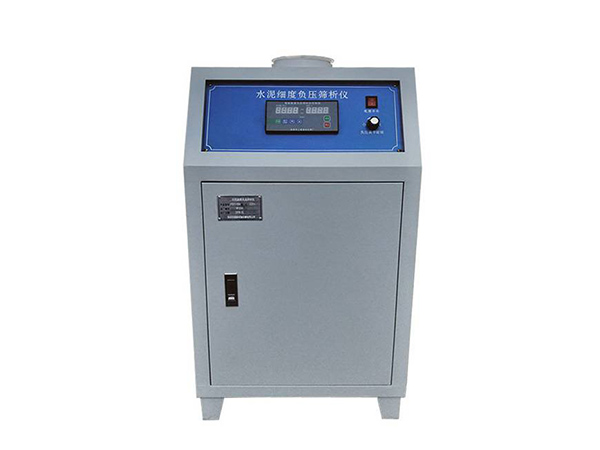
PRODUCT DETAILS
1、 Purpose:
This instrument is a specialized instrument for sieve analysis testing according to the national standard T0501-94 "Method for Testing Cement Fineness -80 μ m Sieve Analyzer". This product has the characteristics of simple structure, easy operation, and reduced energy consumption. It is an instrument needed by cement plants, construction companies, as well as cement research institutes and colleges2. Technical parameters:
1、 Sieve analysis test fineness: 80 μ m
2. Sieve analysis self-control time: 2 minutes
3. Adjustable range of working negative pressure:- 4000-6000Pa
4. Nozzle speed: 30 ± 2r/min
5. Distance between nozzle mouth and sieve: 2-8mm
6. Adding cement sample: 25g
7. Power supply voltage: - 220V
8. Power consumption: 700w
9. Operating noise: ≤ 75dB
10. Dimensions: 540 × 400 × 1000mm
11. Net weight: 40Kg
3. Structural principle:
The negative pressure sieve analyzer mainly consists of a box, a sieve seat, a bucket vacuum cleaner device, and a digital time controller The box is the main structure of the instrument, and all components are installed inside the box The sieve seat is equipped with a synchronous motor, a nozzle, a hard tube, etc., on which the test sieve and sieve cover are placed. The lower end of the hard tube is connected to the cyclone inlet with a flexible hose, and there is also a small opening connected to the negative pressure gauge with a flexible hose The bucket vacuum cleaner serves as a negative pressure source, with its suction port connected to the outlet of the cyclone tube. Its motor can be infinitely adjusted through the pressure knob on the panel to change the working negative pressure of the instrument at any time The cyclone dust collection device consists of a cyclone tube and a dust collection bottle. The configuration of the cyclone simple mouth greatly improves the dust collection efficiency, allowing of cement dust to fall into the dust collection bottle, thereby reducing the frequency of dust cleaning by the vacuum cleaner The digital time controller consists of a digital display screen and a timer. On the one hand, it displays the working time, and on the other hand, it enables the instrument to automatically stop after working for 2 minutes After the negative pressure sieve analyzer is started, the vacuum cleaner and synchronous motor start working, keeping the sieve seat in a negative pressure state. The cement fine powder on the test sieve becomes dynamic under the action of the airflow sprayed from the nozzle. The fine powder with a particle size smaller than the sieve aperture is sucked away by the negative pressure suction through the test sieve, while the fine powder with a particle size larger than the sieve remains on the test sieve, thus completing the screening and meeting the test requirements specified in GB1345-914. Operation steps
1. This instrument is packaged in a box and plastic bag. After opening the box, check whether the product certificate, packing list, user manual and other materials are diverse, and carefully read the user manual.
2、 Place the instrument on a flat and level ground, open the back door, check if all components are installed, and ensure that all connecting ports are tightly connected. Then insert the power plug into a 220V AC power socket with good grounding, and the instrument can be put into use
3、 Set the timer to the desired time, turn on the power and the instrument will start working. When the set time is up, the instrument will automatically stop working. If the negative pressure exceeds the range of "-4000-6000Pa", the pressure regulating knob should be turned to adjust the negative pressure within the range specified by the national standard
4、 When screening according to GB1345-91, first weigh 25g of cement sample with a balance, pour it into the test sieve and cover it with a sieve cover, then start the instrument, wait for the machine to stop, remove the test sieve, pour the sieve residue into the balance for weighing, and obtain the sieve analysis result
Fifth, Maintenance
1. After each use, gently brush both sides of the test sieve with a brush, and check the sieve against sunlight or light. After passing the inspection, store the test sieve in a dry container or plastic bag.
2、 When the test sieve is blocked, it can be placed upside down on the sieve seat, covered with a sieve cover for reverse suction, and then cleaned with a brush. If necessary, the vacuum cleaner suction tube can also be pulled out of the cyclone tube and directly sucked onto the sieve, while cleaning with a brush. If the sieve is severely blocked, the test sieve can be soaked in water for a period of time before brushing
3、 After using the instrument, turn off the power switch and wipe the outer surface of the instrument clean with a cloth
4、 If the cement powder in the dust collection bottle is almost full, the dust collection bottle should be removed from the cyclone tube (clockwise direction) and poured out before being removed (counterclockwise direction)
5、 Vacuum cleaners should pay attention to regular dust cleaning to keep the dust collection bag clean. Confirm that the negative pressure value meets the national standard requirements. When removing the vacuum cleaner, first unplug the power plug from the socket inside the box, and then turn the wrench in front of the vacuum cleaner downwards to detach it from the base. This way, the vacuum cleaner can be removed from the box for dust cleaning
6、 When the instrument is used continuously for too long, it needs to be stopped for heat dissipation to extend the life of the vacuum cleaner motor